Overview
多智能体强化学习(Multi-Agent Reinforcement Learning, MARL)研究的是多个智能体在共享环境中的学习与交互问题。与单智能体强化学习相比,MARL 的困难不只是状态空间和动作空间变大,而是环境本身会随着其他智能体策略的变化而变化,因此每个智能体面对的都不再是一个静态的 MDP,而是一个由其他学习者共同塑造的动态系统。这个变化使得 MARL 同时具有强化学习、博弈论、分布式控制与多智能体系统的特征。
下面,我们从两条互补的线了解这个领域。第一条线是交互结构,也就是任务究竟是完全合作、完全竞争,还是合作与竞争并存的 mixed-motive 场景。第二条轴线是技术机制,也就是算法究竟通过 value factorization、centralized critic、communication learning、opponent modeling、population-based learning 还是 mean-field approximation 来处理多智能体耦合。前者回答“任务是什么”,后者回答“算法怎么处理其他智能体的存在”。
General Formalisms and Training Paradigms
From Single Agent to Multi Agents
MDP and POMDP
为了更清楚地理解多智能体形式化,先从单智能体 MDP 开始。一个马尔可夫决策过程(MDP)通常写成
\[\mathcal{M}=\left(\mathcal{S},\mathcal{A},P,R,\gamma\right),\]其中 $\mathcal{S}$ 是状态空间,$\mathcal{A}$ 是动作空间,$P(s’ \mid s,a)$ 是状态转移函数,$R(s,a)$ 或 $R(s,a,s’)$ 是奖励函数,$\gamma$ 是折扣因子。MDP 的核心假设是:状态 $s_t$ 已经包含了对未来决策有用的全部信息,因此策略可以直接写成
\[\pi(a\mid s).\]在这个设定下,智能体目标通常写成
\[J(\pi)=\mathbb{E}_{\pi,P}\left[\sum_{t=0}^{\infty}\gamma^t R(s_t,a_t)\right].\]MDP 是后续所有形式化的起点:POMDP 是在 MDP 上加入部分可观测,Markov game 是在 MDP 上加入多个智能体,而 Dec-POMDP 则同时引入多智能体与部分可观测。
当单智能体无法直接看到真实状态时,最自然的推广就是 POMDP。一个 POMDP 可以写成
\[\mathcal{P}=\left(\mathcal{S},\mathcal{A},P,R,\Omega,O,\gamma\right),\]其中 $\mathcal{S}$ 是状态空间,$\mathcal{A}$ 是动作空间,$P(s’ \mid s,a)$ 是转移函数,$R(s,a)$ 或 $R(s,a,s’)$ 是奖励函数,$\Omega$ 是观测空间,$O(o\mid s’,a)$ 是观测函数,$\gamma$ 是折扣因子。和 MDP 的差别在于,智能体在时刻 $t$ 接收到的是观测 $o_t$,而不是真实状态 $s_t$。为了让记号更简单,下面先不显式写 history-dependent policy,而把策略简化记为
\[\pi(a\mid o).\]这个写法在严格理论上比 belief policy 或 history policy 更强地简化了问题,但在学习笔记里足够表达 partial observability 的本质:环境底层仍然由隐藏状态驱动,而决策者只能根据观测做近似决策。
Dec-POMDP
Dec-POMDP 是 cooperative MARL 中最标准、也最有代表性的形式化之一。这里首先要明确一点:Dec-POMDP 本身就是 cooperative 模型,它并不是所有 MARL 问题的总框架,而是“多个分布式智能体在共享团队回报下进行部分可观测决策”的标准模型。
一个 Dec-POMDP 通常表示为
\[\mathcal{D}=\left(I,\mathcal{S},\{\mathcal{A}_i\}_{i\in I},P,R,\{\Omega_i\}_{i\in I},O,\gamma\right),\]其中 $I={1,\dots,N}$ 是智能体集合,$\mathcal{S}$ 是环境状态空间,$\mathcal{A}_i$ 是第 $i$ 个智能体的动作空间,$P(s’ \mid s,\mathbf{a})$ 是联合动作诱导的转移函数,$R(s,\mathbf{a})$ 是团队共享回报,$\Omega_i$ 是第 $i$ 个智能体的观测空间,$O(\mathbf{o}\mid s’,\mathbf{a})$ 是联合观测函数,$\gamma$ 是折扣因子。
在这个模型中,每个智能体在执行时只能访问自己的局部观测 $o_i$,并基于局部信息选择动作。为了保持符号简洁,下面不显式写局部历史,而把 decentralized policy 简化写成
\[\pi_i(a_i\mid o_i).\]若记联合策略为 $\boldsymbol{\pi}=(\pi_1,\dots,\pi_N)$,联合动作为 $\mathbf{a}=(a_1,\dots,a_N)$,那么团队目标写成
\[J(\boldsymbol{\pi}) = \mathbb{E}_{\boldsymbol{\pi},P}\left[\sum_{t=0}^{\infty}\gamma^t R(s_t,\mathbf{a}_t)\right].\]Dec-POMDP 抓住了 cooperative MARL 最核心的难点:团队必须通过联合动作影响共享环境并最大化共享回报,但每个智能体执行时又只能依赖自己的局部观测,因此 coordination、credit assignment 与 decentralized execution 会同时出现。
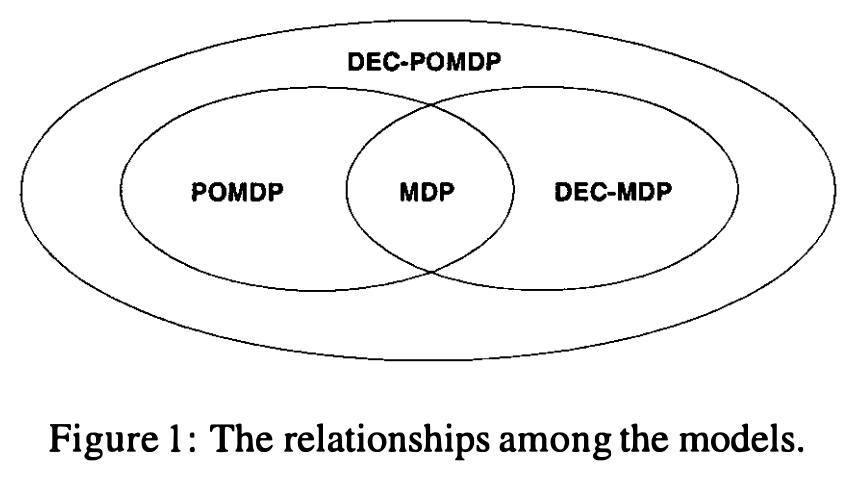 (from Daniel S. Bernstein, et al. The Complexity of Decentralized Control of Markov Decision Processes. UAI. 2000.)
Stochastic / Markov Games
当系统中有多个智能体共享同一环境、且各自可能有不同回报函数时,最常见的统一形式化是随机博弈(stochastic game,也常写作 Markov game)。一个 $N$ 智能体随机博弈通常写成
\[\mathcal{G}=\left(\mathcal{S}, \{\mathcal{A}_i\}_{i=1}^N, P, \{r_i\}_{i=1}^N, \gamma\right)\]其中 $\mathcal{S}$ 是状态空间,$\mathcal{A}_i$ 是第 $i$ 个智能体的动作空间,$P(s’ \mid s, a_1,\dots,a_N)$ 是联合动作诱导的状态转移概率,$r_i(s,a_1,\dots,a_N)$ 是第 $i$ 个智能体的即时回报,$\gamma \in [0,1)$ 是折扣因子。若记联合动作为 $\mathbf{a}=(a_1,\dots,a_N)$,联合策略为 $\boldsymbol{\pi}=(\pi_1,\dots,\pi_N)$,那么第 $i$ 个智能体的目标通常写成
\[J_i(\boldsymbol{\pi})=\mathbb{E}_{\boldsymbol{\pi},P}\left[\sum_{t=0}^{\infty}\gamma^t r_i(s_t,\mathbf{a}_t)\right].\]在这个框架下,单智能体 RL 的很多对象都被保留下来,但都变成了“对联合行为敏感”的版本。例如联合动作价值函数可以写成
\[Q_i^{\boldsymbol{\pi}}(s,\mathbf{a}) = \mathbb{E}_{\boldsymbol{\pi},P}\left[\sum_{t=0}^{\infty}\gamma^t r_i(s_t,\mathbf{a}_t)\mid s_0=s,\mathbf{a}_0=\mathbf{a}\right].\]Markov game 之所以重要,是因为它统一容纳了 fully cooperative、zero-sum competitive 与 general-sum 三类交互结构。对于 cooperative 问题,所有智能体共享同一个回报函数;对于 zero-sum 问题,通常有 $r_1=-r_2$;对于 general-sum 问题,各智能体回报既不完全一致,也不完全相反,因此更容易出现 equilibrium selection、协商与对手塑形等现象。
和 Dec-POMDP 相比,Markov game 的关键差异不是“是否多智能体”,而是它允许一般的奖励结构,而且通常默认状态是可直接使用的。因此,Markov game 更适合描述一般多智能体博弈关系,尤其是 competitive 与 mixed-motive 场景。
POSG
如果把 POMDP 推广到多智能体 setting,更一般的对象是 partially observable stochastic game(POSG)。它可以写成
\[\mathcal{G}^{\mathrm{po}}=\left(\mathcal{S},\{\mathcal{A}_i\}_{i=1}^N,P,\{r_i\}_{i=1}^N,\{\Omega_i\}_{i=1}^N,O,\gamma\right).\]和 Markov game 相比,POSG 额外引入了每个智能体自己的局部观测空间 $\Omega_i$ 和联合观测函数 $O$;和 Dec-POMDP 相比,POSG 不要求共享团队奖励,因此 cooperative、competitive 与 general-sum 三种结构都可以被统一表达。
从关系上看,
- MDP:单智能体、状态可直接使用;
- POMDP:单智能体、部分可观测;
- Dec-POMDP:多智能体、共享团队奖励、部分可观测;
- Markov game:多智能体、奖励结构一般、通常完全可观测;
- POSG:多智能体、奖励结构一般、部分可观测。
其中,Dec-POMDP 可以看作 POSG 在 cooperative setting 下的一个特例;POSG 可以看作 POMDP 在多智能体场景下的推广;而 Markov game 则可以看作 POSG 在 fully observable 情形下更常见的对应。
Training Paradigms
MARL 中最常见的训练范式可以分为 CTE、CTDE 和 DTE 三类。Centralized Training and Execution(CTE)指的是训练和执行都依赖集中式的全局信息与集中式控制器。这类方法在多机器人集中调度中很自然,但它不满足真正的 decentralized execution 约束,因此更接近集中控制而非标准的多智能体分布式决策。
Centralized Training for Decentralized Execution(CTDE)是 cooperative MARL 中最主流的范式。它允许训练阶段使用全局状态、其他智能体动作、联合回报或额外的 centralized critic 来降低学习难度,但执行阶段必须退回到每个智能体仅依赖局部观测来行动。若记训练时可访问的额外信息为 $x_t$,那么可以把 actor 和 critic 的分工粗略写成
\[\pi_i(a_i^t\mid o_i^t),\qquad Q_i(x_t,\mathbf{a}_t)\ \text{or}\ V(x_t).\]这种范式的核心价值不是“训练时偷看答案”,而是利用训练期间可获得的额外信息来缓解 non-stationarity、credit assignment 与 partial observability,同时保持部署时的分布式可执行性。
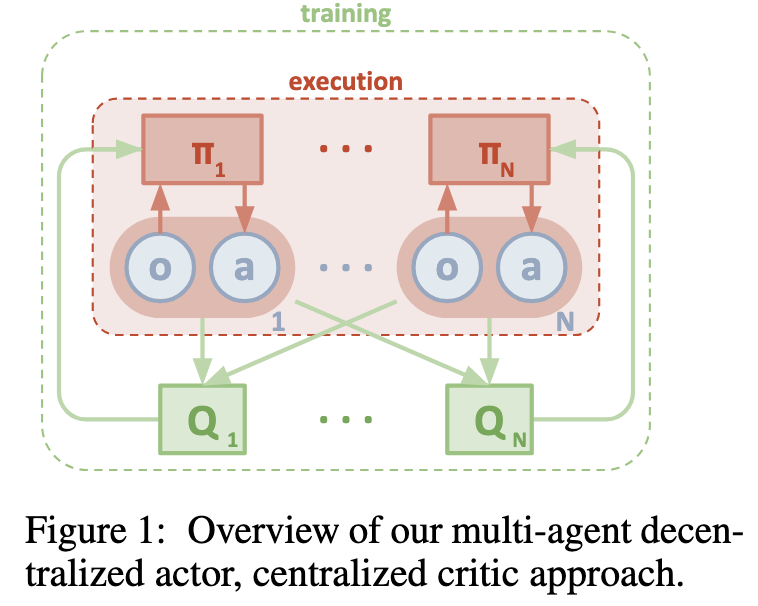 (from Ryan Lowe, et al. Multi-Agent Actor-Critic for Mixed Cooperative-Competitive Environments. NIPS. 2017.)
Decentralized Training and Execution(DTE)则要求训练和执行都只能使用局部信息。它更贴近严格通信受限、隐私受限或完全分布式的实际系统,但往往更难优化,因为训练阶段也无法借助 centralized critic 或全局状态来稳定学习。
Core Challenges
1. Non-Stationarity
在单智能体 RL 中,环境转移通常假设是固定的;但在 MARL 中,对任意一个智能体而言,其他智能体也在同时学习,因此环境动力学和奖励结构都在不断变化。即使外部物理环境没有变化,由于其他智能体策略更新,某个 agent 眼中的有效转移核也会改变。这就是 MARL 最根本的 non-stationarity 问题。
这个问题会直接破坏很多单智能体 RL 里默认成立的假设。例如 experience replay 假设过去数据和当前策略处于相近分布,但在多智能体场景中,旧样本往往是由过时的对手或队友策略生成的;又例如 off-policy 更新依赖于环境近似平稳,而多智能体学习会让同一状态下的回报含义不断漂移。因此,很多 MARL 方法都会通过 centralized critic、fingerprints、population training 或者更严格的 on-policy 训练来缓解 non-stationarity。
2. Credit Assignment
在 cooperative MARL 中,团队共享回报很自然,但共享回报会立刻带来 credit assignment 问题:当一个团队在时刻 $t$ 收到奖励时,究竟是哪个智能体、哪个动作、或者哪个局部决策片段对这次奖励真正负责?如果不能有效解决这个问题,那么某些智能体就可能成为 lazy agents,只依赖其他智能体完成任务,或者因为奖励信号太粗糙而学不到有效的局部策略。
credit assignment 的困难既体现在时间维度,也体现在智能体维度。时间上,许多奖励是 delayed reward;智能体上,回报是联合行为的结果而不是单个动作的直接后果。COMA 中的 counterfactual baseline、difference rewards、value factorization 以及一些 advantage decomposition 方法,本质上都是在试图回答“如果只改变某个智能体的动作,而保持其他因素不变,结果会如何变化”这一问题。
3. Joint Action Explosion
| 多智能体问题的联合动作空间通常随智能体数量指数增长。如果第 $i$ 个智能体有 $ | \mathcal{A}_i | $ 个动作,那么联合动作空间大小就是 |
这个指数增长会让很多原本在单智能体场景中简单的问题变得困难。例如联合 Q 函数 $Q(s,\mathbf{a})$ 的表示成本会迅速上升;在 cooperative setting 中做 $\arg\max_{\mathbf{a}} Q(s,\mathbf{a})$ 也会变得困难;在 competitive 或 mixed setting 中,stage game 的 equilibrium computation 也会随着联合动作空间扩大而变得昂贵。因此,value factorization、monotonic mixing、mean-field approximation、graph factorization 等方法都可以被看作是对 joint action explosion 的结构化近似。
4. Partial Observability
在 MARL 中,许多环境天然是部分可观测的。每个智能体只能看到自己的局部观测,无法直接访问完整状态,也不知道其他智能体真实看到了什么、记住了什么、准备做什么。这意味着智能体不仅要“对环境建模”,还要“对其他智能体的认知状态建模”。如果没有记忆机制、belief representation 或 communication channel,仅凭当前局部观测往往不足以做出高质量决策。
因此,recurrent policy、belief modeling、communication learning、teammate modeling 和 opponent modeling 都在很大程度上是对 partial observability 的回应。Hanabi 和很多 imperfect-information game 之所以困难,并不是因为动作空间特别大,而是因为智能体必须在局部信息约束下推断他人的知识与意图。
5. Equilibrium and Generalization
在 competitive 或 mixed-motive 场景中,仅仅提高训练回报并不能说明问题已经解决。一个策略也许能在固定对手上取得高回报,但可能对新的对手分布极不鲁棒;也许能在 self-play 训练中收敛到某个行为模式,但这个行为模式可能远离 Nash equilibrium,或者非常容易被 exploitation。也就是说,这类问题不仅涉及 optimization,还涉及 equilibrium quality 与 out-of-distribution generalization。
因此,在 zero-sum 和 general-sum MARL 中,evaluation 往往需要超出平均回报本身,进一步考察 exploitability、cross-play、population robustness、best-response performance 和 partner generalization。OpenSpiel、PSRO 以及各种 league-based/self-play 方法的重要性,恰恰来自它们能够提供比单一平均回报更有辨识力的评测视角。
6. Scalability and Heterogeneity
真实多智能体系统往往不是由少量同质智能体构成的。在 agent 数量增加之后,除了表示和优化复杂度增长之外,还会同时出现异质动作空间、不同角色、局部图结构、动态通信拓扑、资源竞争与协作约束等问题。简单的 parameter sharing 在同质 cooperative benchmark 上可能足够有效,但在异质和大规模场景中往往不再成立。
这也是为什么 large-population MARL、graph MARL、role-based decomposition、attention-based interaction modeling 在近几年持续受到关注。它们都试图解决一个共同的问题:如何在不显式枚举所有 agent-agent 交互的前提下,保留对关键交互结构的刻画能力。
A Taxonomy
从两个相互正交的维度来分类现有MARL研究:一个维度描述任务的 interaction structure,另一个维度描述算法的 technical mechanism。
| 维度 | 类别 | 核心问题 | 代表工作 |
|---|---|---|---|
| Interaction structure | Fully cooperative | coordination, shared return, credit assignment | VDN, QMIX, COMA, MAPPO |
| Interaction structure | Fully competitive (zero-sum) | minimax value, exploitability, self-play | Minimax-Q, NFSP, Deep CFR, DeepNash |
| Interaction structure | Mixed (general-sum) | equilibrium selection, reciprocity, co-adaptation | MADDPG, LOLA, PR2, PSRO |
| Technical mechanism | Communication learning | what / when / to whom to communicate | CommNet, RIAL, DIAL, TarMAC |
| Technical mechanism | Opponent modeling / theory of mind | infer goals, predict reactions, shape learning dynamics | SOM, LOLA, PR2, R2G |
| Technical mechanism | Large-population / scalable MARL | compress many-agent interaction into structured summaries | Mean Field MARL |
其中第一条维度回答的是“任务中的利益关系是什么”,而第二条维度回答的是“算法通过什么技术手段处理多智能体耦合”。例如 communication learning 可以出现在 cooperative 问题中,也可能出现在 mixed-motive 场景中;opponent modeling 虽然在 competitive setting 里更自然,但在 cooperative Hanabi 一类问题里同样重要。
Taxonomy by Interaction Structure
Fully Cooperative
Value-based
在 fully cooperative MARL 中,所有智能体共享同一个团队目标,因此形式化通常最接近 Dec-POMDP。问题的关键在于:每个智能体只能看到局部观测,却需要与其他智能体共同形成一个高质量的联合策略。这里最核心的技术矛盾是,训练时我们希望利用全局信息来降低学习难度,但执行时又必须满足 decentralized execution 的约束。
Value-Decomposition Networks (VDN). Sunehag et al. 2017.
VDN 的出发点非常直接:既然团队共享一个回报,那么不妨把团队动作价值函数表示成各个智能体局部价值函数的和,即
这个分解形式的优点是简单、易训练,而且保证了 decentralized greedy action selection 的可行性,因为联合最优动作可以由各智能体局部贪心动作组合得到。VDN 的局限也同样明显:它只能表达 additive interaction,无法刻画复杂的协同依赖。
QMIX: Monotonic Value Function Factorisation for Deep Multi-Agent Reinforcement Learning. Rashid et al. 2018.
QMIX 在 VDN 的基础上进一步放宽了表示能力。它不再要求 $Q_{\mathrm{tot}}$ 是简单求和,而是通过 mixing network 学习从 individual utilities 到 joint value 的映射(输入为$Q_1$到$Q_n$,输出为$Q_{tot}$),同时要求这个映射满足单调性约束
这个条件保证了 individual-global-max(IGM)原则,即联合动作的贪心选择仍然可以分解为各个智能体的局部贪心选择。QMIX 之所以成为 cooperative MARL 的经典基线,是因为它在表达能力和可分解性之间给出了一个很实用的折中;它的问题则在于,单调性假设仍然排除了某些更复杂的协同结构。
Policy Gradients
Counterfactual Multi-Agent Policy Gradients (COMA). Foerster et al. 2018.
COMA 代表的是另一条 cooperative 主线:centralized critic actor-critic。它的关键不是 value factorization,而是通过一个 centralized critic 为每个智能体提供 counterfactual advantage,从而缓解 multi-agent credit assignment。对智能体 $a$,COMA 的 advantage 写成
这个 baseline 保持其他智能体动作不变,只对当前智能体的动作做边缘化,因此更接近“如果只有我改动作,结果会怎样”的 counterfactual 问题。COMA 的历史意义很强,因为它把 credit assignment 明确地写进了 multi-agent actor-critic 框架;不过从后续实践看,COMA 往往不如后续方法(“While COMA has been very influential, it isn’t widely used since newer methods tend to outperform it” – Christopher Amato. An Introduction to Centralized Training for Decentralized Execution in Cooperative Multi-Agent Reinforcement Learning)。
IPPO: Is Independent Learning All You Need in the StarCraft Multi-Agent Challenge? Schroeder de Witt et al. 2020.
IPPO 对 cooperative MARL 的重要性在于,它直接挑战了“cooperative MARL 必须依赖 centralized critic 或 joint value learning 才能在困难任务上工作”的常见印象。这篇论文研究的是 SMAC 上的 Independent PPO:每个智能体只学习基于局部观测的策略和局部 value function,不使用 centralized critic。论文的核心结论是,尽管 independent learning 在理论上有 non-stationarity 等缺陷,但 PPO 的一些稳定化机制,尤其是 policy clipping,足以让这种简单方法在不少 hard SMAC maps 上与甚至优于一些 joint-learning baseline。
从目标函数上看,IPPO 仍然遵循标准 PPO 的 clipped objective,只不过每个智能体都基于自己的局部信息独立更新:
\[L_i^{\mathrm{IPPO}}(\theta_i) = \mathbb{E}\left[ \min\left( r_{i,t}(\theta_i)\hat{A}_{i,t},\; \mathrm{clip}(r_{i,t}(\theta_i),1-\epsilon,1+\epsilon)\hat{A}_{i,t} \right) \right],\]其中
\[r_{i,t}(\theta_i)=\frac{\pi_{\theta_i}(a_i^t\mid o_i^t)}{\pi_{\theta_i^{\mathrm{old}}}(a_i^t\mid o_i^t)}.\]这篇论文里,IPPO 最值得记住的不是一个新公式,而是一组非常“朴素但有效”的设计选择。
部署时的关键做法:
- 每个智能体只使用自己的局部观测执行策略,不依赖 centralized critic 或全局状态;
- 在同质智能体场景下,actor 参数共享,这样既保留 decentralized execution,又提高样本效率与泛化一致性。
训练时的关键 tricks:
- 使用局部观测 critic,而不是 centralized value function;论文发现把 full state 塞给 critic 在一些 hard SMAC maps 上反而更差;
- 使用 GAE、entropy regularization 和 PPO 的 policy clipping;
- 同时对 value function 使用 value clipping,作者的 ablation 表明 policy clipping 是关键,而 value clipping 在部分 hard maps 上也有帮助;
- 对 advantage 做一次整体 normalization,而不是按 mini-batch 做 normalization;
- 使用 gradient clipping、参数共享,以及针对 SMAC 的 stacked observations + CNN/MLP 编码器。
这篇工作的核心启发是:在 cooperative MARL 里,centralized critic 并不是永远更好。特别是在 SMAC 这类环境中,保持更新简单、限制策略剧烈变化,有时比引入更强的 centralized information 更稳。
MAPPO: The Surprising Effectiveness of PPO in Cooperative Multi-Agent Games. Yu et al. 2022.
MAPPO 的重要性不在于提出了一个全新的理论对象,而在于它系统证明了:经过细致实现与调参的 PPO,在 cooperative benchmark 上可以成为一个极强的 baseline。与 IPPO 相比,MAPPO 的关键区别不在 actor,而在 critic。作者将 policy 保持为 decentralized policy,但允许 value function 在训练时接收 centralized inputs,因此算法属于标准 CTDE 路线。论文中对 MAPPO 和 IPPO 的区分也写得很清楚:当 value function 使用 centralized inputs 时称为 MAPPO;当 policy 和 value function 都只用局部输入时称为 IPPO。
MAPPO 的核心优化目标仍然是 PPO 的 clipped surrogate objective:
\[L^{\mathrm{clip}}(\theta) = \mathbb{E}\left[ \min\left( r_t(\theta)\hat{A}_t,\; \mathrm{clip}(r_t(\theta),1-\epsilon,1+\epsilon)\hat{A}_t \right) \right],\]其中
\[r_t(\theta)=\frac{\pi_\theta(a_t\mid o_t)}{\pi_{\theta_{\mathrm{old}}}(a_t\mid o_t)}.\]MAPPO 的真正贡献在于把“PPO 在 cooperative MARL 中怎样才会 work”这件事拆成了一组可以复现的 best practices。
部署时的关键做法:
- actor 在执行时仍然只依赖局部观测,因此保持 decentralized execution;
- 在同质智能体环境中,policy 和 value network 都采用 parameter sharing;
- centralized information 只进入训练期的 value function,而不进入执行期的 actor。
训练时的关键 tricks:
- 使用 value normalization 来稳定 value learning;作者发现它“几乎从不伤害、经常明显有益”;
- 为 centralized critic 设计合适的输入表示:最好同时包含 global features 和 local, agent-specific features,并避免无意义地扩大 critic 输入维度;
- 控制 training data reuse:困难任务通常使用 5 或 10 个 epochs,简单任务用 15 个 epochs,并尽量避免把一批数据切成过多 mini-batches;
- 将 PPO clipping ratio $\epsilon$ 控制在 0.2 以下,并把它当成“稳定性和收敛速度之间的折中参数”来调;
- 使用足够大的 batch size,以换取更稳定的梯度估计与更好的最终性能;
- 另外,论文实现里还采用了 parameter sharing、GAE、advantage normalization 和 value clipping 这些 PPO 常用稳定化做法。
MAPPO 最重要的结论是:PPO 在 cooperative MARL 里并不天然弱,问题更多出在“把单智能体 PPO 的实现习惯生硬搬到多智能体环境”上。作者通过系统 ablation 说明,一旦 critic 输入、数据复用和 clipping 被调对,MAPPO 可以在多个 cooperative benchmark 上达到与 off-policy 方法相当甚至更好的表现。
Fully Competitive (Zero-Sum Game)
在 fully competitive 的 zero-sum setting 中,任务目标不再是最大化共享团队回报,而是围绕 minimax value、best response 与近似 Nash equilibrium 展开。若两方收益满足 $r_1=-r_2$,那么问题的核心目标可以写成
\[V^\star(s)=\max_{\pi_1}\min_{\pi_2} \mathbb{E}_{\pi_1,\pi_2,P}\left[\sum_{t=0}^{\infty}\gamma^t r_1(s_t,a_t^1,a_t^2)\mid s_0=s\right].\]这类问题的重点因此从“团队协调”转向“策略稳定性与可利用性”。平均回报当然仍重要,但 exploitability、regret、cross-play robustness 往往是更本质的评价指标。
Markov Games as a Framework for Multi-Agent Reinforcement Learning / Minimax-Q. Littman. 1994.
Littman 的工作是 zero-sum stochastic games 的经典起点。Minimax-Q 把单智能体 Q-learning 推广到两人零和 Markov game,并把状态价值定义为对 stage game 的 minimax 解:
随后再用这个 $V(s’)$ 做 Bellman-style 更新:
\[Q(s,a,o)\leftarrow (1-\alpha)Q(s,a,o)+\alpha\left[r+\gamma V(s')\right].\]这篇工作的意义在于,它明确指出了多智能体 RL 与博弈求解的联系:一旦其他智能体不再是环境噪声,而是理性对手,那么 value update 本身就必须包含 equilibrium reasoning。
Neural Fictitious Self-Play (NFSP). Heinrich and Silver. 2016.
NFSP 的核心思想是把 fictitious play 的 two-timescale 结构用深度学习实现出来:一方面用强化学习训练近似 best response,另一方面用监督学习追踪 average policy。它的意义并不在于某个单一公式,而在于训练机制本身:通过在 best-response policy 与 average policy 之间切换,NFSP 可以在 imperfect-information game 中逼近更稳定的博弈解概念。
Deep Counterfactual Regret Minimization (Deep CFR). Brown et al. 2019.
Deep CFR 把 CFR 的 regret minimization 思想与函数逼近结合起来,适合处理大规模 imperfect-information game。与标准 deep RL 不同,Deep CFR 的优化对象并不是一个普通的 value function,而是 counterfactual regret 与平均策略。
DeepNash / Mastering the Game of Stratego with Model-Free Multiagent Reinforcement Learning. Perolat et al. 2022.
DeepNash 面向的是大规模、长时程、不完全信息的零和对抗问题。它的贡献不只是打赢了 Stratego,更重要的是展示了在复杂 imperfect-information game 中,model-free multiagent learning 也可以与 equilibrium-oriented 训练目标结合。
Mixed (General-Sum Game)
mixed 或 general-sum MARL 往往最接近真实社会交互,因为智能体之间既可能合作,也可能竞争,而且利益关系会随状态、时间或群体构成而变化。与 zero-sum 问题不同,general-sum 场景通常存在多个可能的 equilibrium;与 fully cooperative 问题不同,这些 equilibrium 的 welfare、fairness 和稳定性也可能完全不同。因此,这一类问题经常同时要求智能体学会协作、博弈、预测、塑形和适应。
Friend-or-Foe Q-learning. Littman. 2001, and Nash Q-Learning. Hu and Wellman. 2003.
这两类早期方法代表了 general-sum stochastic game 的理论起点。Friend-or-Foe Q-learning 通过对其他智能体做 friend / foe 的结构化假设来简化求解,而 Nash Q-learning 则更直接地把每个状态下的 stage game Nash equilibrium 写进 Bellman 更新中。它们的重要意义在于:general-sum MARL 从一开始就不是“把 cooperative 和 competitive 简单平均一下”,而是必须正视 equilibrium selection 与多解性。
Multi-Agent Actor-Critic for Mixed Cooperative-Competitive Environments (MADDPG). Lowe et al. 2017.
MADDPG 是 deep mixed-motive MARL 的里程碑工作,也是 centralized critic 这条线在 mixed cooperative-competitive 环境中的代表作。它的基本思路是:每个智能体在执行时仍然只根据自己的局部观测采取动作,但在训练时,critic 可以访问更丰富的全局信息和所有智能体的动作,从而缓解由其他学习者引起的 non-stationarity。于是,对 agent $i$,MADDPG 维护一个 deterministic actor $\mu_i(o_i)$ 和一个 centralized critic $Q_i^\mu(x,a_1,\dots,a_N)$,其中 $x$ 表示训练时可访问的全局状态或其他集中式信息。
在 critic 侧,MADDPG 继承 DDPG 的 temporal-difference 回归思想。对 agent $i$,bootstrap target 写成
\[y_i = r_i+\gamma Q_i^{\mu'}(x',a_1',\dots,a_N')\Big|_{a_j'=\mu_j'(o_j')},\]其中 $\mu_j’$ 和 $Q_i^{\mu’}$ 是 target networks。于是 critic 的 loss function 可以写成
\[\mathcal{L}(\phi_i) = \mathbb{E}_{(x,\mathbf{a},r,x')\sim\mathcal{D}} \left[ \left(Q_i^\mu(x,a_1,\dots,a_N)-y_i\right)^2 \right].\]actor 侧则使用 deterministic policy gradient。对智能体 $i$,策略梯度写成
\[\nabla_{\theta_i}J(\theta_i) = \mathbb{E}_{x,\mathbf{a}\sim\mathcal{D}} \left[ \nabla_{\theta_i}\mu_i(o_i)\, \nabla_{a_i}Q_i^\mu(x,a_1,\dots,a_N)\Big|_{a_i=\mu_i(o_i)} \right].\]这个式子的含义是:actor 只负责改变自己的动作,而 critic 在求梯度时会把其他智能体动作一起考虑进去,因此 agent $i$ 实际上是在“联合行为诱导的价值面”上更新自己的 deterministic policy。也正因为 critic 依赖所有智能体动作,MADDPG 才能够把“其他智能体也在学习”这件事部分吸收到 critic 的输入中。
MADDPG 的贡献不只是把 DDPG 机械地搬到多智能体 setting,而是明确提出了 decentralized actor + centralized critic 的训练结构,并把它推广到 cooperative、competitive 和 mixed 三种环境。论文里还提出了Inferring Policies of Other Agents 和 policy ensemble 训练,用来用于估计其他智能体的策略(移除知道其他智能体策略的假设),并提高在多样对手分布下的鲁棒性。
Learning with Opponent-Learning Awareness (LOLA). Foerster et al. 2017.
LOLA 的核心洞见是:在 mixed-motive 问题中,如果你只对“对手当前的策略”做 best response,那么你忽略了一个事实,即你的更新本身也会改变对手下一步的更新方向。换句话说,另一个智能体不是静态环境,而是正在学习的对手。为此,论文先把 naive learner 的更新写成
即只对自己的当前目标做梯度上升。而在 LOLA 中,agent 1 会把对手未来的一步学习更新也代入自己的目标。如果 agent 2 预计会按
\[\theta_2'=\theta_2+\eta \nabla_{\theta_2}V_2(\theta_1,\theta_2)\]更新,那么 agent 1 的目标不再是简单优化 $V_1(\theta_1,\theta_2)$,而是优化“对手更新一步之后”的收益:
\[\theta_1' = \theta_1 + \alpha \nabla_{\theta_1} V_1\!\left(\theta_1,\, \theta_2+\delta\nabla_{\theta_2}V_2(\theta_1,\theta_2)\right).\]这个更新式的意义在于:我不仅关心当前回报,还关心我这一步会如何塑造对方下一步的学习轨迹。若进一步做一阶展开,可以看到 LOLA 比 naive learner 多出一个 opponent-shaping term,它显式刻画了“我对对手学习过程的影响”。也正是因为这个项,LOLA 能在 iterated prisoner’s dilemma 一类社会困境中学出比普通 gradient learner 更具策略性的行为模式。它的局限也很清楚:一旦更新里出现跨智能体的高阶梯度,优化就更脆弱,因此后续才会出现 SOS 这类稳定化方法。
Probabilistic Recursive Reasoning (PR2). Wen et al. 2019.
PR2 进一步把高阶推理带进 MARL。它不再满足于“我估计对手当前会做什么”,而是显式建模“对手会如何根据我的动作做条件反应”。论文最关键的一步,是把 joint policy 从普通的乘积分解,重写成带有条件对手策略的形式。对 agent $i$,作者从它的视角把 joint policy 重写为
从对手视角,也可以对称地写成
\[\pi_\theta(a^i,a^{-i}\mid s) = \pi_{\theta_{-i}}^{-i}(a^{-i}\mid s)\, \pi_{\theta_i}^{i}(a^i\mid s,a^{-i}).\]它的含义非常关键:PR2 不再把对手看成一个只依赖状态的静态策略分布,而是把对手策略重写成一个条件策略$\pi^{-i}(a^{-i}\mid s,a^i)$,也就是“给定我选择了什么动作,对手将如何响应”。这一点正是 recursive reasoning 和普通 opponent modeling 的核心区别。
基于这个 joint policy 分解,PR2 对 agent $i$ 的优化目标可以写成
\[\eta_i = \int_s \int_{a^i} \pi^i(a^i\mid s) \int_{a^{-i}} \pi^{-i}(a^{-i}\mid s,a^i) Q^i(s,a^i,a^{-i})\,da^{-i}\,da^i\,ds.\]也就是说,agent $i$ 在选动作时,不是对一个静态对手分布求期望,而是对“对手对我动作的条件响应分布”求期望。由此得到的 recursive reasoning policy gradient 形式为
\[\nabla_{\theta_i}\eta_i = \mathbb{E}_{s\sim p,\;a^i\sim \pi^i} \left[ \nabla_{\theta_i}\log \pi_{\theta_i}^i(a^i\mid s) \int_{a^{-i}} \pi^{-i}(a^{-i}\mid s,a^i)\, Q^i(s,a^i,a^{-i})\,da^{-i} \right].\]在真实训练中,agent 通常无法直接访问对手的真实条件策略 $\pi^{-i}(a^{-i}\mid s,a^i)$,所以 PR2 又引入了一个参数化的 opponent conditional policy$\rho_{\phi^{-i}}^{-i}(a^{-i}\mid s,a^i)$ 去近似它。于是 decentralized recursive reasoning policy gradient 变成
\[\nabla_{\theta_i}\eta_i \approx \mathbb{E}_{s\sim p,\;a^i\sim \pi^i} \left[ \nabla_{\theta_i}\log \pi_{\theta_i}^i(a^i\mid s) \int_{a^{-i}} \rho_{\phi^{-i}}^{-i}(a^{-i}\mid s,a^i)\, Q^i(s,a^i,a^{-i})\,da^{-i} \right].\]若把上式中的积分记成一个条件 soft-Q / expected-Q 项,那么可进一步写成
\[\nabla_{\theta_i}\eta_i \approx \mathbb{E}_{s\sim p,\;a^i\sim \pi^i} \left[ \nabla_{\theta_i}\log \pi_{\theta_i}^i(a^i\mid s)\, Q_{\rho_{\phi^{-i}}^{-i}}^i(s,a^i) \right],\]其中
\[Q_{\rho_{\phi^{-i}}^{-i}}^i(s,a^i) = \int_{a^{-i}} \rho_{\phi^{-i}}^{-i}(a^{-i}\mid s,a^i)\, Q^i(s,a^i,a^{-i})\,da^{-i}.\]这个式子的含义是:策略梯度的权重不再是普通的 $Q^i(s,a^i)$,而是“在我选了动作 $a^i$ 之后,对手按照条件响应模型行动时的期望 Q 值”。这正是 PR2 的技术核心。
从算法流程看,PR2 基本上是在交替优化三部分对象:
- 当前智能体的 policy $\pi_{\theta_i}^i(a^i\mid s)$;
- 条件对手模型 $\rho_{\phi^{-i}}^{-i}(a^{-i}\mid s,a^i)$;
- 联合动作价值函数 $Q^i(s,a^i,a^{-i})$。
论文把这种过程解释成一种 EM-style learning procedure:先固定 $\rho$ 和 $Q$ 去更新 policy,再利用新轨迹更新条件对手模型和 Q-function。作者由此给出了 PR2-Q 和 PR2-Actor-Critic 两个版本。直观上,PR2 比普通 opponent modeling 更强,因为普通对手建模更像是在学“对手通常会做什么”,而 PR2 学的是“对手会怎样响应我”。这也是为什么它在一些 non-transitive、存在复杂相互适应的 differential games 中表现突出。
Policy-Space Response Oracles (PSRO) / A Unified Game-Theoretic Approach to Multiagent Reinforcement Learning. Lanctot et al. 2017.
传统independent RL方法不仅存在non-stationarity问题,还会过度拟合训练过程中其他智能体的特定策略,执行阶段与未见过的智能体交互时泛化性极差。
PSRO 的重要性在于它改变了训练单位:与其直接试图学到一个单一最终策略,不如维护一个策略种群(policy population),并在种群层面显式做 game-theoretic reasoning。设第 $i$ 个玩家当前维护的策略集合为 $\Pi_i$,那么 PSRO 首先通过 rollout 估计这些策略之间的 empirical payoff table,然后在这个经验博弈上用 meta-solver 求一个 meta-strategy $\sigma_i \in \Delta(\Pi_i)$。接着,对每个玩家训练一个对当前对手 population 的 best response oracle:
新学到的 best response 会被加入策略集合,形成新的 population,再重新计算 empirical game 和新的 meta-strategy。这个循环的关键思想是:复杂多智能体学习问题往往不是“找到单个最优策略”,而是“找到一个足够有代表性的策略种群,并在种群层面逼近 equilibrium”。这使 PSRO 特别适合处理 non-transitive、multi-modal 或 mixed-motive 环境,因为在这些环境里,单一策略往往不稳定,也无法概括整体博弈结构。PSRO 也是后续 population-based MARL、league training 和 empirical game-theoretic analysis 的一个重要起点。
Specific Techniques
Communication Learning
communication learning 不是一种单独的任务结构,而是一组在部分可观测多智能体系统中显式学习“交流什么、何时交流、向谁交流”的技术。它通常出现在 cooperative 场景中,但在 mixed-motive 环境中同样可能重要,因为 communication 既可以促进协作,也可能被操纵、伪装或有成本约束。
CommNet. Sukhbaatar, Szlam, Fergus. 2016.
CommNet 的代表性在于把多智能体通信通道设计成连续可微的神经网络组件。若第 $\ell$ 层第 $i$ 个智能体的隐藏状态是 $h_i^{(\ell)}$,那么一个典型的 communication summary 可以写成
再用它更新下一层表示
\[h_i^{(\ell+1)}=f\!\left(h_i^{(\ell)},c_i^{(\ell)}\right).\]这种设计的意义在于,通信本身成为端到端可学习的内部表示,而不是手工指定的离散协议。它非常优雅,但也因为过于“全员平均通信”而缺乏选择性。
RIAL / DIAL. Foerster et al. 2016.
RIAL 把 communication 当作一个需要强化学习的动作,而 DIAL 则更进一步,在训练阶段允许梯度穿过通信通道传播,执行时再把消息离散化。这个设计解决了一个很现实的问题:如果从一开始就把消息当成完全离散且不可导的动作,学习会变得非常困难;而若训练时允许连续消息与梯度流动,则可以显著降低 credit assignment 难度。RIAL/DIAL 因而成为 communication learning 中非常经典的一组工作。
TarMAC. Das et al. 2019.
TarMAC 解决的是更细粒度的问题:不是所有通信都应该被广播给所有人,更合理的机制是“向谁发送、谁该接收、何时多轮交互”。它使用 attention 机制让通信具备 targeted routing 的能力。若智能体 $j$ 发送的 value 是 $v_j$,而 $\alpha_{ij}$ 是从 $j$ 到 $i$ 的注意力权重,那么接收方 $i$ 获得的消息可以写成
这类方法的重要意义在于,它把 communication 从“共享内存”变成了“结构化信息路由”,更适合复杂协作与大规模系统。
Opponent Modeling and Theory of Mind
opponent modeling 指的是显式建模其他智能体的目标、策略、知识状态或学习动态;theory of mind 风格的方法则进一步强调对“他人如何看待我、他人知道什么、他人将如何响应”这类高阶认知结构的建模。在 mixed 和 competitive MARL 中,这一支尤其关键,但在 cooperative imperfect-information task 中同样重要。
Self Other-Modeling (SOM). Raileanu et al. 2018.
SOM 的思想非常直观:如果我知道自己的 policy 是如何根据隐变量和观测做决策的,那么我也许可以利用“自己”这个模型来反推对方的隐目标或隐状态。换句话说,SOM 用自己的策略机制去解释他人的行为,这是一种非常典型的 theory-of-mind 式建模方式。它的贡献主要在于建模视角,而不是某个单一公式。
LOLA. Foerster et al. 2017.
LOLA 在这里再次出现,是因为它不仅属于 mixed-motive MARL,也属于 opponent modeling 的代表作。它建模的不是对手当前策略,而是对手的学习更新本身,因此是一种“对手将如何变化”的建模。这比静态 opponent model 更强,也更不稳定,因此后续出现了 SOS 等工作来提高其优化稳定性。
PR2. Wen et al. 2019.
PR2 则把对他人反应的建模推进到递归层面。它的核心启发是:许多多智能体问题中的推理不是一阶的“对方会做什么”,而是高阶的“对方知道我会做什么,因此会进一步调整自己的行为”。从这个角度看,PR2 是 opponent modeling 与 recursive reasoning 的一个重要连接点。
Recursive Reasoning Graph (R2G). Ma et al. 2022.
R2G 的意义在于,它把 recursive reasoning 的结构和图表示结合起来,用图来表达智能体之间谁在影响谁、谁在推断谁。这一步很重要,因为在多智能体系统里,递归推理并不总是全连接的;很多时候,关键交互只发生在局部结构上。R2G 因而把 theory of mind 方向与 graph-based MARL 联系了起来。
Large-Population / Scalable MARL
当系统中存在大量智能体时,直接表示 $Q(s,a_1,\dots,a_N)$ 往往既不必要也不可扩展。严格来说,“Large-Population / Scalable MARL” 并不是单一算法族,而是一组为了避免联合状态-动作空间爆炸、通信开销爆炸和训练成本爆炸而发展出来的方法路线。就我现在的理解,这些路线大致可以分成四类:
- 用 population statistics 或 collective variables 替代对每个个体的显式建模;
- 用低阶 interaction factorization 近似高维联合 Q-function;
- 用 graph neural networks 或 attention 只保留局部、稀疏、动态的重要交互;
- 用 curriculum 或 agent-number transfer 解决“随着 agent 数量增加,训练本身越来越难”的问题。
Mean Field Multi-Agent Reinforcement Learning. Yang et al. 2018.
Mean Field MARL 的代表性在于,它把多智能体相互作用近似成个体与 mean field 的作用。若 $\mu_t$ 表示邻域中其他智能体动作的经验分布,那么单个智能体的 Q 函数近似写成
而不是直接表示 $Q_i(s_t,a_1^t,\dots,a_N^t)$。这个近似背后的哲学是:当群体规模足够大时,单个对手的身份不再重要,真正重要的是整体行为的统计结构。Mean Field MARL 因而为 many-agent games、群体控制和 anonymous interaction 提供了一条非常自然的路线。
Policy Gradient With Value Function Approximation For Collective Multiagent Planning. Nguyen, Kumar, Lau. 2017.
这篇工作研究的是 CDec-POMDP(collective Dec-POMDP),核心思想和 mean-field 非常接近:当系统中真正起作用的是“某类 agent 在某个区域有多少个”或“群体的 aggregate behavior 是什么”时,就没有必要保留每个个体的身份。论文通过 collective statistics 来建模 joint reward 和 environment dynamics,并进一步提出 actor-critic 方法做优化。它的重要意义在于:large-population MARL 不一定非要走 mean-field game 那条线,也可以走“collective state / count-based abstraction”的路线。对交通、车队调度、资源分配这类场景来说,这种建模往往比逐个 agent 建模更自然。
Factorized Q-Learning for Large-Scale Multi-Agent Systems. Zhou et al. 2018.
这篇工作代表的是另一条路线:不去把其他 agent 全部平均掉,而是假设高维联合 Q 函数可以由低阶 interaction 近似表示。论文把 joint-action Q-function 看成一个高阶张量,再用 pairwise factorization 去逼近它。直观上,它试图用“个体项 + 两两交互项”的结构近似复杂多体耦合,从而把原本不可处理的 joint Q-learning 变成一个还能优化的近似问题。这类方法的优势是:它比简单 mean-field 保留了更多 interaction structure;局限则在于,一旦真正重要的是高阶协同而不是 pairwise interaction,factorized approximation 就可能不足。
Graph Convolutional Reinforcement Learning. Jiang et al. 2020.
如果说 mean-field 和 factorization 的思路是“做统计压缩”或“做函数分解”,那么图神经网络路线的思路则是:现实中的多智能体交互往往天然稀疏、局部、动态,因此真正需要建模的不是“所有 agent 和所有 agent 的关系”,而是一个随时间变化的 interaction graph。GCRL 的贡献就在于把 agent 间影响建模为图卷积过程,让每个智能体通过邻域卷积逐步聚合高阶关系特征。它非常适合处理局部协作、网络路由、局部感知下的群体协调,因为这些问题的关键从来都不是全连接协调,而是图结构上的关系传播。
Efficient and Scalable Reinforcement Learning for Large-Scale Network Control. Trott et al. 2024.
关注的核心问题就是:如何在大规模网络控制系统里,让强化学习既可扩展又可部署。论文强调的是 topology-aware decentralization:每个控制器只根据局部观测和局部邻域信息决策,但训练时结合 learned system model、局部通信和图结构归纳偏置,在数百个 agent 的网络里仍然能保持性能与样本效率。它和前面的 graph-based scalable MARL 有相当强的连续性,但比一般 graph RL 论文更偏“真实大规模控制系统”的工程落地,也更清楚地展示了 scalable MARL 在 networked control 上的价值。
Multi-Agent Game Abstraction via Graph Attention Neural Network. Liu et al. 2020.
G2ANet 代表的是 graph-based scalability 的另一个重要方向:不仅要用图表示 agent 之间的关系,还要进一步学习“哪些关系其实根本不重要”。论文提出两阶段 attention 机制,用来判断两个 agent 是否存在有效交互以及这种交互有多重要。这个视角非常适合 large-scale MARL,因为很多大规模系统里,真正困难的不是 agent 数量本身,而是 agent 之间潜在关系过多。如果模型能自动识别并忽略无关交互,就等于主动做了 game abstraction。就这个意义上说,G2ANet 更像是“可学习的交互稀疏化 / 抽象化”方法。
From Few to More: Large-scale Dynamic Multiagent Curriculum Learning. Wang et al. 2019.
这篇工作和前面几篇略有不同。严格来说,它不是在提出一种新的大规模系统建模形式,而是在解决“随着 agent 数量增加,训练本身变得越来越难”的问题。DyMA-CL 的核心思想是:先在少量智能体的较简单设置中学,再逐步增加 agent 数量,把训练过程组织成一种 curriculum。为了让这种 curriculum 能在不同 agent 数量之间迁移,论文还提出了 Dynamic Agent-number Network(DyAN)来处理输入维度随 agent 数量变化的问题。因此,如果把 scalable MARL 分成“模型可扩展性”和“训练可扩展性”两部分,那么 DyMA-CL 更适合归到后者。
Learning to Simulate Self-Driven Particles System with Coordinated Policy Optimization. Wu et al. 2021.
Coordinated Policy Optimization(CoPO)关注的是在大量自驱粒子 / 交通参与者系统中学习可协调、可泛化的群体行为,它强调的是如何通过协调式策略优化,让局部决策诱导出合理的宏观群体动力学。它和严格意义上的 mean-field、factorized Q、graph abstraction 不完全一样,因为它的重点更偏向 emergent coordination 而不是通用的可扩展性建模。
从整体上看,
- mean-field / collective methods 适合 anonymous interaction 或群体统计主导的问题;
- factorized interaction methods 适合仍需保留局部耦合结构、但又不能显式表示完整 joint action 的问题;
- graph-based methods 适合交互稀疏、局部、动态的系统;
- curriculum-based methods 适合“单次直接训练太难,但结构上可以从小规模逐步迁移”的场景;
- coordination-oriented large-population methods 则更强调在大量 agent 下学出稳定且合理的群体行为。
这类方法的共同目标都是让 agent 数量增长时,表示复杂度、训练复杂度和泛化难度不要同步爆炸。它们的共同局限也很明显:一旦近似结构与真实交互结构错配,例如本该建模高阶异质协同却被 mean-field 平均掉,或者本该是全局耦合却被图模型过度局部化,性能就会迅速下降。
Benchmarks and Surveys
Benchmarks
SMAC and SMACv2.
The StarCraft Multi-Agent Challenge(SMAC)长期以来是 cooperative MARL 最有影响力的 benchmark。它强调局部观测下的团队微操、credit assignment 与战术协调,因此非常适合评估 cooperative CTDE、value factorization 与 centralized critic 方法。SMACv2 则进一步指出原始 SMAC 存在随机性不足、部分任务容易被 open-loop policy 取巧等问题,因此更强调 generalization、closed-loop coordination 和 procedural variation。这个演变很有启发性:benchmark 本身并不是中性的,它会决定社区认为“什么算难”。
Hanabi.
Hanabi 是 fully cooperative 但又带有强 imperfect-information 特征的 benchmark。它的重要性在于,它把 cooperative MARL 从“只看协调动作”推进到了“还要看信念推理、惯例形成和 theory of mind”。如果一个 cooperative 方法只在 SMAC 类任务中表现好,而在 Hanabi 这种隐信息协作环境中表现一般,那么它对 MARL 的解释力其实是有限的。
MPE and Google Research Football.
Multi-Agent Particle Environments(MPE)是 mixed-motive MARL 中极其常见的实验平台,因为它实现简单、任务轻量、支持 cooperative、competitive 与 mixed cooperative-competitive 三种设置,特别适合快速验证算法思想。它的问题是任务相对玩具化。Google Research Football 则更接近复杂团队对抗,它把长时程规划、自博弈与团队竞争结合得更自然,因此更适合观察多智能体连续控制与 self-play 的长期行为。
OpenSpiel and Melting Pot.
OpenSpiel 的价值在于,它把 cooperative、zero-sum、general-sum、perfect-information 和 imperfect-information 游戏统一到一个实验接口中,因此非常适合做 equilibrium、exploitability 与 cross-play 研究。Melting Pot 则把重点放在 social reasoning、partner generalization 与开放式社会互动上,它提醒我们:一个 MARL 算法如果只能适应固定训练伙伴,那它未必具备真正的社会智能。
Surveys
Peter Stone and Manuela Veloso, 2000: Multiagent Systems: A Survey from a Machine Learning Perspective.
这篇 survey 很早,但它的价值并没有消失,因为它从一开始就把多智能体问题放在一个比“深度 cooperative RL”更宽的背景中:异质性、通信、协商、角色分工、社会规范和资源管理都已经被明确提出。对今天最大的提醒是,MARL 本来就不应被局限为某几个 benchmark 和算法族。
Hernandez-Leal, Kartal, Taylor, 2019: A Survey and Critique of Multiagent Deep Reinforcement Learning.
这篇 survey 是 deep MARL 社区最经典的综述之一。它既整理了 communication、cooperation、emergent behavior 与 agents modeling agents 这些主要分支,也很早就系统指出了 replay buffer non-stationarity、parameter sharing、RNN 和记忆机制、过拟合与评测偏置等实践问题。它特别适合作为 deep MARL 的第一层地图。
Zhang, Yang, Basar, 2021: A Selective Overview of Theories and Algorithms.
这篇综述更偏理论导向,它把 MARL 放回 stochastic games、extensive-form games、networked MARL 与 mean-field games 的框架中。它的价值在于帮助我把 cooperative、competitive 和 mixed setting 放到统一的博弈论背景下理解,而不是只记住一串算法名称。
Amato, 2024: An Introduction to CTDE in Cooperative MARL.
这篇综述的范围更窄,但非常适合梳理 cooperative CTDE 的主线。它把 value function factorization 和 centralized critic actor-critic 两大支系讲得非常清楚,也提醒读者:CTDE 是 cooperative MARL 中的重要范式,但并不等于整个 MARL。
Yang, et al. 2025. Game-Theoretic Multiagent Reinforcement Learning.
这部持续更新的长篇综述 / 专著最适合作为 game-theoretic MARL 的全景入口。它覆盖 stochastic games、Dec-POMDP、extensive-form games、identical-interest / zero-sum / general-sum 和 mean-field 等多个层面,并把 safe and robust MARL、model-based MARL、multi-agent meta-RL、foundation-model-based directions 等更近年的主题也串联起来。
Other Taxonomies
Based on the heterogeneity and whether communicate (Peter Stone and Manuela Veloso, 2000: Multiagent Systems: A Survey from a Machine Learning Perspective)
- homogeneous non-communicating agents
- heterogeneous non-communicating agents
- homogeneous communicating agents
- heterogeneous communicating agents
Based on the tasks (Hernandez-Leal, et al. 2019. A survey and critique of multiagent deep reinforcement learning)
- Emergent behaviors
- Learning communication
- Learning cooperation
- Agents modeling agents
Based on the game-theoretic perspective (Yang, et al. 2025. Game-Theoretic Multiagent Reinforcement Learning)
- Learning in indentical-interest games
- Learning in zero-sum games
- Learning in general-sum games
- Learning in games when N -> infinity
Paper List
Foundations and Surveys
- Stone and Veloso. Multiagent Systems: A Survey from a Machine Learning Perspective. 2000.
- Hernandez-Leal et al. A Survey and Critique of Multiagent Deep Reinforcement Learning. 2019.
- Zhang, Yang, Basar. Multi-Agent Reinforcement Learning: A Selective Overview of Theories and Algorithms. 2021.
- Amato. An Introduction to Centralized Training for Decentralized Execution in Cooperative Multi-Agent Reinforcement Learning. 2024.
- Yang et al. Game-Theoretic Multiagent Reinforcement Learning. arXiv monograph.
Cooperative MARL
- Sunehag et al. Value-Decomposition Networks For Cooperative Multi-Agent Learning. 2017.
- Rashid et al. QMIX: Monotonic Value Function Factorisation for Deep Multi-Agent Reinforcement Learning. 2018.
- Foerster et al. Counterfactual Multi-Agent Policy Gradients. 2018.
- Schroeder de Witt et al. Is Independent Learning All You Need in the StarCraft Multi-Agent Challenge?. 2020.
- Son et al. QTRAN: Learning to Factorize with Transformation for Cooperative Multi-Agent Reinforcement Learning. 2019.
- Wang et al. QPLEX: Duplex Dueling Multi-Agent Q-Learning. 2021.
- Yu et al. The Surprising Effectiveness of PPO in Cooperative Multi-Agent Games. 2022.
Competitive and Game-Theoretic MARL
- Littman. Markov Games as a Framework for Multi-Agent Reinforcement Learning. 1994.
- Littman. Friend-or-Foe Q-learning in General-Sum Games. 2001.
- Hu and Wellman. Nash Q-Learning for General-Sum Stochastic Games. 2003.
- Heinrich and Silver. Deep Reinforcement Learning from Self-Play in Imperfect-Information Games. 2016.
- Brown et al. Deep Counterfactual Regret Minimization. 2019.
- Perolat et al. Mastering the Game of Stratego with Model-Free Multiagent Reinforcement Learning. 2022.
Mixed-Motive, Opponent Modeling, and Population Methods
- Lowe et al. Multi-Agent Actor-Critic for Mixed Cooperative-Competitive Environments. 2017.
- Foerster et al. Learning with Opponent-Learning Awareness. 2017.
- Lanctot et al. A Unified Game-Theoretic Approach to Multiagent Reinforcement Learning. 2017.
- Raileanu et al. Modeling Others using Oneself in Multi-Agent Reinforcement Learning. 2018.
- Wen et al. Probabilistic Recursive Reasoning for Multi-Agent Reinforcement Learning. 2019.
- Letcher et al. Stable Opponent Shaping in Differentiable Games. 2019.
- Ma et al. Recursive Reasoning Graph for Multi-Agent Reinforcement Learning. 2022.
Communication and Scalability
- Sukhbaatar et al. Learning Multiagent Communication with Backpropagation. 2016.
- Foerster et al. Learning to Communicate with Deep Multi-Agent Reinforcement Learning. 2016.
- Nguyen et al. Policy Gradient With Value Function Approximation For Collective Multiagent Planning. 2017.
- Zhou et al. Factorized Q-Learning for Large-Scale Multi-Agent Systems. 2018.
- Das et al. TarMAC: Targeted Multi-Agent Communication. 2019.
- Wang et al. From Few to More: Large-scale Dynamic Multiagent Curriculum Learning. 2019.
- Yang et al. Mean Field Multi-Agent Reinforcement Learning. 2018.
- Jiang et al. Graph Convolutional Reinforcement Learning. 2020.
- Liu et al. Multi-Agent Game Abstraction via Graph Attention Neural Network. 2020.
- Wu et al. Learning to Simulate Self-Driven Particles System with Coordinated Policy Optimization. 2021.
- Trott et al. Efficient and Scalable Reinforcement Learning for Large-Scale Network Control. 2024.
Benchmarks and Evaluation
- Samvelyan et al. The StarCraft Multi-Agent Challenge. 2019.
- Bard et al. The Hanabi Challenge: A New Frontier for AI Research. 2020.
- Kurach et al. Google Research Football: A Novel Reinforcement Learning Environment. 2019.
- Lanctot et al. OpenSpiel: A Framework for Reinforcement Learning in Games. 2019.
- Ellis et al. SMACv2: An Improved Benchmark for Cooperative Multi-Agent Reinforcement Learning. 2023.
- Agapiou et al. Melting Pot 2.0. 2023.